
After Sangin - Part 5
No Better Friend, No Worse Enemy

There were victories for us in Sangin.
Like any campaign, they started out small – in some cases, almost insignificant – but over time there was a cumulative effect. The valley’s civilian population was indeed the center of gravity, and the Brit and Marine units that predated 3/7 had, for the most part, laid a solid foundation with the people and leaders of the district.
Perhaps most impactful – at least for those who regularly found themselves outside the wire – was the Marines’ reputation for violence.
“No better friend, no worse enemy” was real.
It wasn’t an empty promise when we told the local leaders, “Please work with us; help us help you. Don’t cross us. Don’t support the Taliban, or everyone will pay the price.” That wasn’t to say if the Afghans didn’t cooperate, we would lay waste to the valley. But, at the same time, the Marines were always ready to get in a gunfight if the situation presented itself.
The experience base 3/7’s junior and mid-level leaders – the fire team leaders, squad leaders, platoon sergeants, and many of the senior lieutenants and captains – brought to the table was invaluable.
To be sure, there were still young leaders in the battalion who believed the best course of action was to lead with a heavy hand – that there was a high-explosive solution to any problem.
There were also those who believed the best course of action was to glass the place. And there were others who believed “hearts and minds” should translate to “two the heart and one to the mind.” Those were the leaders whose approach we had to either change quickly or, failing that, show them the door.
Despite the heavy kinetics of the early years in the valley, there wasn’t a high-explosive solution to the problem in Sangin.
Stabilizing the district, supporting the government, rebuilding the infrastructure… none of those were problem sets we could shoot our way out of. The ever-present locals on the battlefield – and our mandate to prevent civilian casualties at all costs – muddied an already complicated situation.
It was, as Col Eric Smith – my regimental commander for the deployment’s first half – routinely said: operating in Sangin was like having to get in a knife-fight in a phonebooth without breaking any glass.
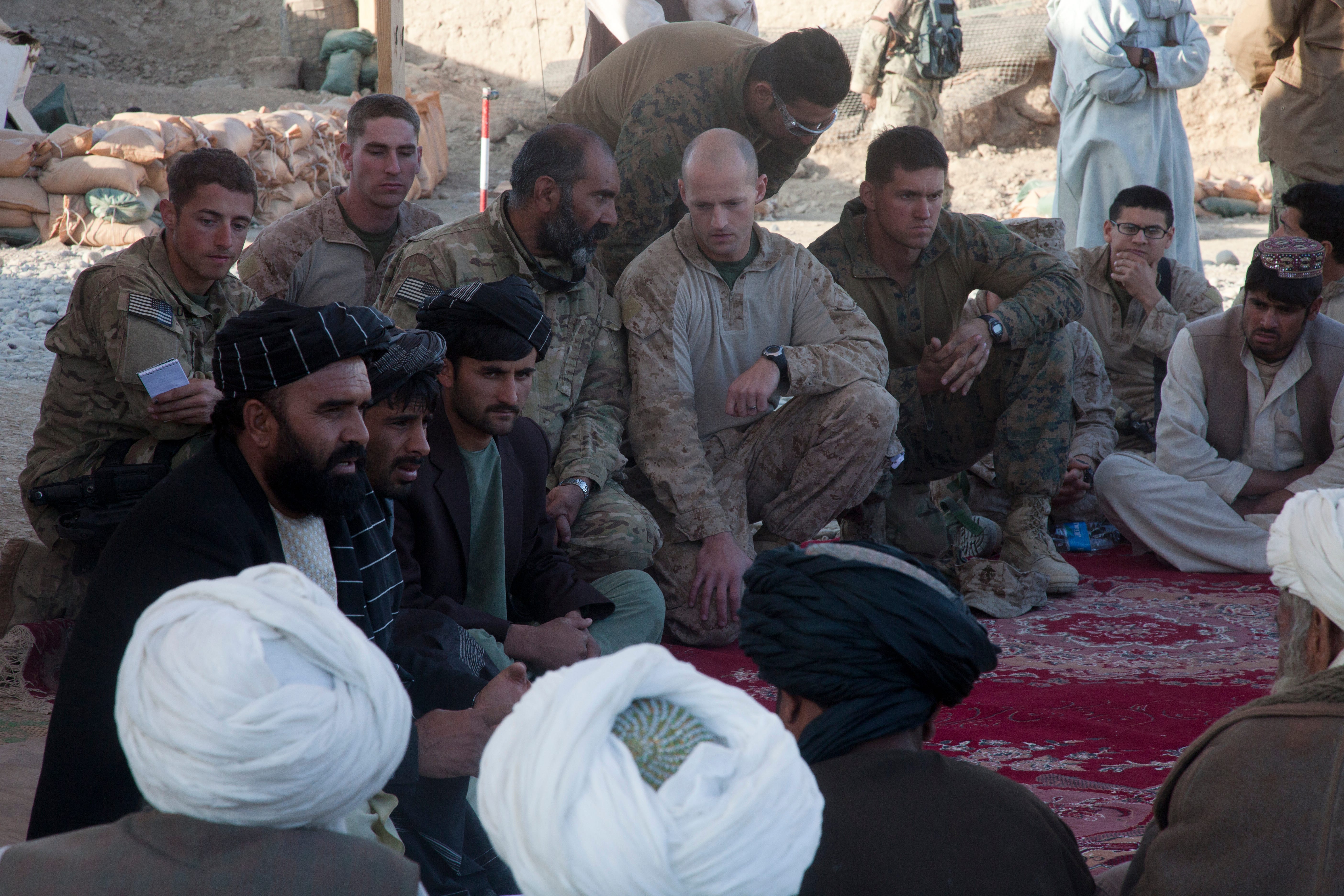
Solving problems in Afghanistan meant establishing relationships with the locals.
That meant pausing a patrol when you were exhausted so you could sit down and share a glass of chai with one of the villagers you recognized – even when you knew the glass had just been washed in one of the nearby, sewage-filled canals.
The guy who wrote Three Cups of Tea may have turned out to be a complete fraud in the end, but his basic premise was just as true in an underdeveloped society like rural Afghanistan as is in twenty-first century America: no one wants to do business with you until they trust you. That trust often begins by sharing a drink or a meal.
Because of their ubiquitous presence all day, every day throughout the valley, 3/7’s squad leaders became our bid for victory in Sangin.
The battalion’s overall campaign to deepen the hold would be dead on arrival without the sergeants and corporals embracing our strategy, compelling their young Marines to do the same, and applying it bit by bit during their daily patrols.
As the deployment progressed, there were tangible signs that the Marines’ presence was making a positive difference.
Sometimes it was a reduction in IED strikes and discoveries. Sometimes it was a villager casually producing information about bad actors in the area. Sometimes it was something as benign as the locals smiling and waving at the Marines as they passed by rather than sneering, frowning, or simply displaying indifference.
The areas in the district the Marines couldn’t pacify or bring over to our side often became the focus of our kinetic actions.
Battalion-level operations in Sangin were practically impossible. With Marines occupying dozens of outposts across the valley, the most we could muster at any given time was a composite rifle company comprising elements from across the battalion.
The two most significant operations 3/7 conducted in 2011-12 were just that: company-level, targeted clearance operations with very specific, albeit limited, objectives. In both cases, enemy contact was light, but we still took casualties.
Still, the effects of those operations were wide-reaching. The Marines produced actionable intelligence, their deliberate movement through the district flushed out hidden Taliban fighters, and they sent a clear message that the battalion could mass its available forces when the need arose.
Throughout the deployment, we emphasized the development of the ANSF – the Afghan National Army, the Afghan National Civil Order Police, and the Afghan Uniformed Police.
Despite the endemic corruption and ineffectualness of our Afghan military partners, we knew that failure to invest in them would mean failure for the overall security mission in the district.
Not long into our tour, we shifted from Marine-only patrols to partnered operations. It began with ANSF ones and twos accompanying the Marines to give the patrols a “partnered flavor.” ANSF participation gradually grew, and by the end the Marines seemed to be just tagging along for the ride.
The developing partnership also included gradually turning over ownership of our outposts to the ANSF.
At the beginning of the deployment, the average patrol base was a bermed-in compound, with the Marines spread out among the buildings. By deployment’s end, the partnered outposts housed more Afghans than Americans, and the Marines’ living accommodations were limited to dusty troop tents.
The cultural barriers slowly came down. It became common to find Marines and Afghan service members hanging out together at partnered outposts, sharing food, movies, magazines, and tobacco, and generally shooting the shit.
We weren’t so naïve that we thought we could trust all the ANSF members to do their jobs well. The key became identifying the few who could – the few who genuinely cared. Those were the ones in whom the Marines invested the most.
# # #
Stay Tuned for Part 6.