
After Sangin - Part 2
Everything is Your Fault

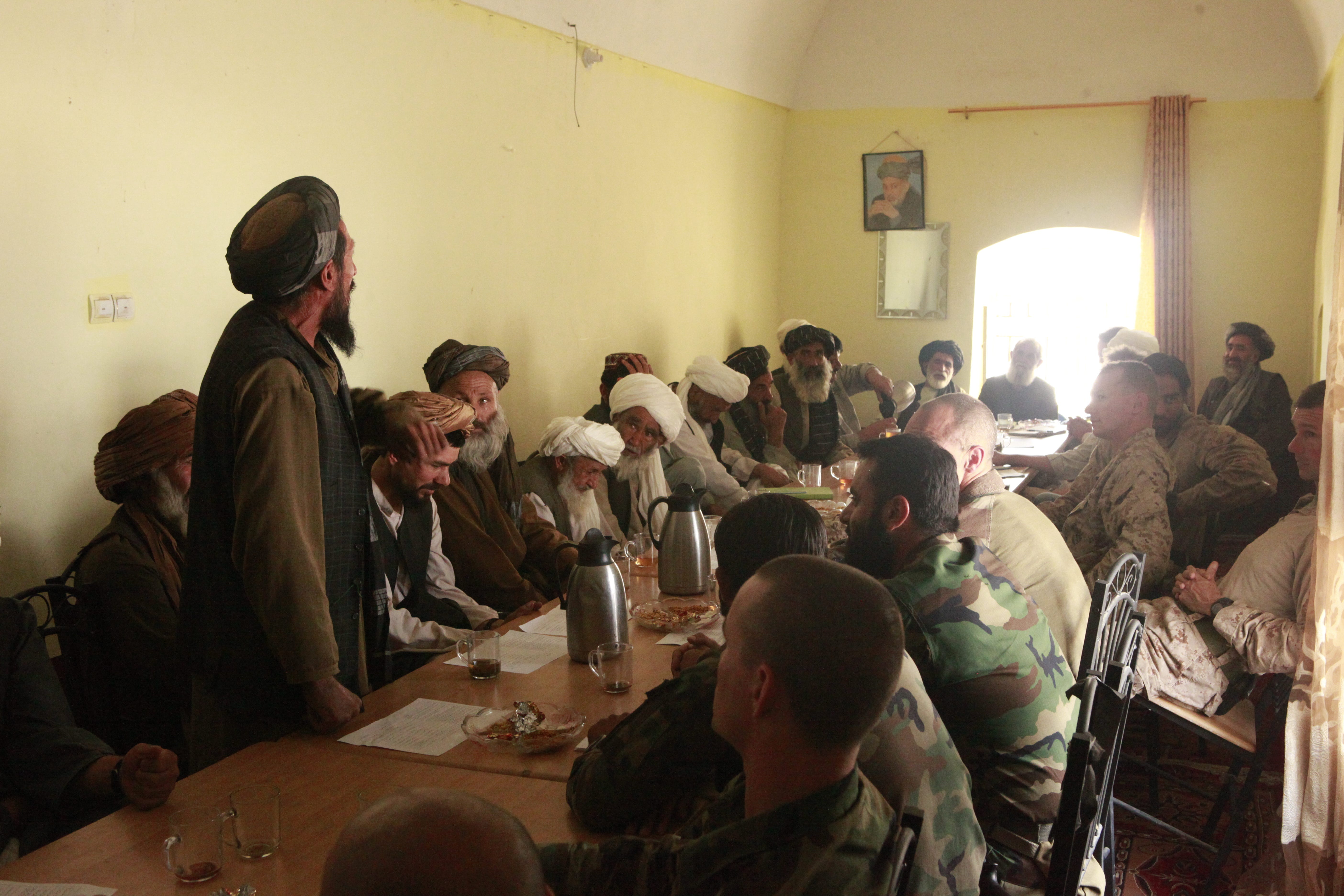
There could be no doubt: the mission briefed well.
Our overall goal in Afghanistan was to stabilize the Afghan government and prevent Al Qaeda from regaining its grip on the country and using it as a renewed base of terror operations. To achieve that goal meant conducting counterinsurgency operations against an entrenched Taliban force and – just as important –supporting and bringing over to our side a possibly more entrenched local government in the Sangin District.
To that end, we absorbed and internalized the Marine Corps’ new “CHB” approach: first clear the district, then hold it, and then build on the successes. But a linear approach didn’t fit Helmand’s patchwork communities. There were areas, like the southern green zone’s Pan Qaleh, that constantly needed clearing, while in other areas the people were ready to move on and rebuild their lives and infrastructure.
3/7’s marching orders in September 2011 were clear: deepen the hold. Again, it briefed well. The implication was the previous three battalions had cleared the district and had begun to hold it. All we had to do was build on the success of the previous units. But it wasn’t that easy. It never is.
During my pre-deployment site survey to Sangin in late summer of 2011, 1/5’s commander, LtCol Tom Savage, spent an uncomfortable amount of time talking to me about his unit’s casualties. By deployment’s end, 1/5 suffered seventeen men killed in action. Before them, 3/5 had lost twenty-five of their own. With that knowledge, I could only walk away from the site survey with one thought:
Jesus Christ, you call this the “hold” stage?
When I returned home and my wife asked what the deployment would look like, I simply said, “We’re gonna lose a lot of Marines.” But I was committed to keeping them all alive. That was my job. When I told my regimental commander about my priority to bring all my men home, he brought me back down to earth with a healthy dose of reality.
“You know that is all but a mathematical impossibility,” he said. “Maybe you should focus on trying to bring back as many as possible.”
#
When the Marines first arrived in force in 2010, operations in the Sangin Valley were distributed, fragmented, and often ununified. There were pockets of relative safety and security across the district, areas which were anchored on major FOBs like Jackson, Nolay, and Inkerman.
Travel throughout the battlespace was sketchy.
The main road was Route 611, which stretched north all the way to the Kajaki Dam. A paved two-lane road that led into Sangin from the south, 611 was an unfinished route in the fall of 2010. The asphalt ended just north of the district center, and beyond it the Taliban had heavily mined the route with massive IEDs.
Until late 2010, movements along 611 were often measured in days, not hours, due to the frequent IED strikes along the way. It was only after dedicated explosive clearing efforts and the construction of more outposts that security conditions were set for a third-nation initiative to pave the rest of 611 all the way to Kajaki.
As the area of operations expanded in 2010 and 2011, so too did the various Marine commanders’ roles as battlespace owners. Regular requests by the local government and Afghan National Security Forces (ANSF) leaders for the Marines to build more outposts were honored. But there weren’t enough Marines to go around.
A doctrinal counterinsurgency force ratio figure regularly cited was the need for roughly twenty troops for every 1,000 inhabitants. By that logic, Sangin required only 400 Marines. But that wouldn’t have been nearly enough. In 2011-12, 3/7’s numbers totaled approximately 1,200 service members – a number which was closer to sixty troops per 1,000 locals – and it still wasn’t enough.
The result was a force stretched thin – and our grudging acknowledgement that we couldn’t be everywhere all at once. The realization that parts of the district were effectively enemy-controlled – and beyond our ability to influence – was sobering indeed.
#
Being a battlespace owner in Sangin was a nightmare for other reasons.
With the 611 artery to Kajaki running through its district center – and with FOB Shukvani and the road to Musa Qala just across the Helmand River – Sangin was an Old West waypoint for the continuous resupply effort to sustain Marines in northern Helmand.
Different units regularly transited our battlespace; sometimes they coordinated their movement with us, sometimes they didn’t. On more than one occasion, resupply convoys rolled through our gates, the vehicle crews rattled by an ambush or IED strike against their convoy just down the road.
At the time of 3/7’s return in 2011, multiple units operated there, and the district itself wasn’t united under a single battlespace owner. 3/7 occupied the immediate areas of the district center, the northern and southern green zones, and the brown zone. Farther up 611, elements of another Marine battalion attempted to control the upper Sangin Valley.
Additionally, inside the valley’s northern sector, a special operations task force operated in a small, sequestered piece of battlespace we called “SOF Island.” The Marines were forbidden from operating inside the SOF Island bubble, where bearded operators were conducting village stability operations.
Frequent “visits” to 3/7’s area of operations by higher-tier teams compounded the SOF problem. Sangin was a hotbed of high-value individuals – enemy leaders so vital that our Coalition masters in Kabul would never trust a regular grunt unit like 3/7 to capture or kill them.
We had little notice of planned SOF operations, and I was powerless to do anything about them. Most of the time it was my operations officer walking into my office with a map, announcing, “The dudes in the black helicopters are showing up tonight.” We could only sit back and wait for the inevitable aftermath.
Regardless of the multiple units operating across the valley, it was all still inside the district boundaries. No matter what happened, the district governor and his council always turned to me – especially if what happened was bad.
Marines killed a local’s dog during a patrol? My issue to resolve.
Random resupply convoys tearing ass through the bazaar? My issue to resolve.
A SOF team shot up a village during a night raid? My issue to resolve.
3/7 eventually assumed battlespace ownership of the entire district, but little changed apart from boundaries on the map. It was there, in Sangin, that I came to realize the old saying about command – that you are responsible for everything your unit does or fails to do – had evolved into “everything is your fault.”
# # #
Stay tuned for Part 3.